
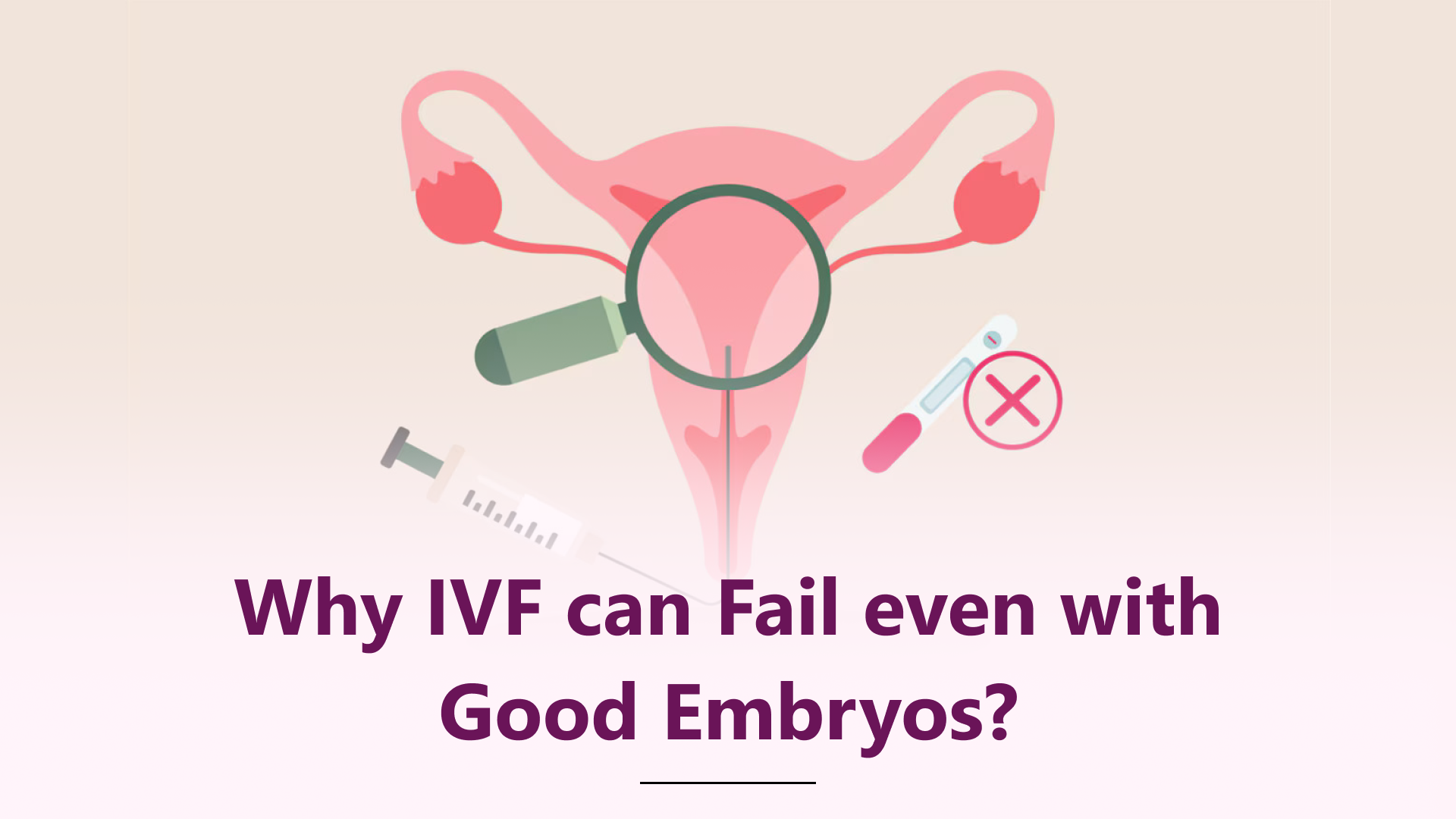

Few outcomes are harder to process than a failed IVF cycle after being told the embryos looked excellent. It feels counterintuitive — if the embryo was graded well, shouldn’t pregnancy have followed? At our IVF center in Bhopal, this is one of the most common questions we help patients work through, and the honest answer is that embryo quality is only one half of the implantation equation.
Rethinking ‘Good Embryo, Guaranteed Success’
A top-grade embryo significantly improves the odds of implantation, but it does not guarantee it. As explained in our related article on how many good-quality embryos are actually enough, implantation depends equally on the uterine environment receiving that embryo — a factor entirely separate from how the embryo looks under the microscope.
Uterine Lining and Receptivity Issues
The uterine lining needs to reach an adequate thickness and the right hormonal ‘window’ for an embryo to implant successfully. Structural issues such as uterine fibroids, particularly those distorting the uterine cavity, can physically or hormonally interfere with this receptivity even when the lining otherwise appears healthy on a routine scan.
Undiagnosed Chronic Pelvic Conditions
Conditions like endometriosis or chronic inflammation, often presenting as chronic pelvic pain, can create an inflammatory environment in the pelvis that interferes with implantation, even when they haven’t been formally diagnosed before the IVF cycle. This is one reason a pelvic pain history is always worth mentioning explicitly to your specialist, even if it seems unrelated.
Immunological and Clotting Factors
In a subset of patients experiencing repeated implantation failure, immune system activity or blood clotting disorders can prevent an otherwise healthy embryo from establishing a stable connection to the uterine lining. These factors are usually investigated specifically after two or more unexplained failed transfers, rather than as part of a first-cycle work-up.
Ovarian Cysts and Hormonal Imbalance During the Cycle
An untreated ovarian cyst present during stimulation or transfer can sometimes disrupt hormone levels needed to prepare the uterine lining properly, even if the cyst itself seems unrelated to the embryo transfer procedure. Screening for and addressing cysts before a cycle begins is a standard precaution for exactly this reason.
Lifestyle and Timing Factors
Stress, poor sleep, smoking, and certain medications can all subtly affect the uterine environment during the critical implantation window. While these factors alone rarely cause implantation failure outright, they can compound other underlying issues and are usually reviewed as part of a broader evaluation after a failed cycle.
What to Do After a Failed Cycle
A single failed cycle, even with good embryos, does not necessarily mean something is fundamentally wrong. It usually means it’s time for a more targeted evaluation before the next attempt. At our female fertility clinic in Bhopal, we review uterine receptivity, hormonal timing, and any undiagnosed conditions before recommending the next transfer, rather than simply repeating the same protocol.
Conclusion
A failed IVF cycle with good embryos is disappointing, but it is rarely a dead end — it is usually information pointing toward a specific, addressable factor. Understanding the difference between embryo quality and implantation success is the first step toward a more targeted next attempt. Speak with Dr. Sonil Srivastava at our IVF center in Bhopal to review what may have affected your cycle.
Frequently Asked Questions
How many failed IVF cycles before further testing is recommended?
Typically after two or more unexplained failures with good-quality embryos, more detailed implantation-focused testing is recommended.
Can uterine lining thickness be improved for a future cycle?
Yes, in many cases hormonal adjustments or addressing an underlying condition can improve lining thickness and receptivity for a subsequent transfer.
Does stress actually cause implantation failure?
Stress alone is unlikely to be the sole cause, but chronic stress can compound other biological factors affecting implantation.
Is recurrent implantation failure the same as a miscarriage?
No — implantation failure means the embryo did not implant at all, while a miscarriage occurs after a confirmed pregnancy has been established.
Can fibroids always be seen on a routine ultrasound before IVF?
Most fibroids are visible on a standard scan, but smaller or specifically located fibroids sometimes require additional imaging to assess their impact on the uterine cavity.
Should both partners be re-evaluated after a failed cycle?
Yes, a comprehensive review after a failed cycle typically includes both partners, since sperm quality factors can also contribute to implantation outcomes.
Had a failed cycle despite good embryos? Book a detailed implantation failure evaluation with Dr. Sonil Srivastava before your next attempt. Get in touch with Dr. Sonil Srivastava’s IVF team.