

Introduction
An ovarian endometrioma — commonly called a ‘chocolate cyst’ — is a cyst on the ovary filled with old, dark menstrual blood, caused by endometriosis. When a woman with an ovarian endometrioma is trying to conceive through IVF, one of the most challenging clinical decisions arises: should the cyst be surgically removed first, or should IVF proceed directly?
This question does not have a single universal answer. The decision depends on cyst size, the woman’s ovarian reserve, her age, whether she has symptoms, whether she has had previous ovarian surgery, and the expertise available. Getting this decision right can make a significant difference to both short-term IVF outcomes and long-term ovarian health.
What Is an Ovarian Endometrioma?
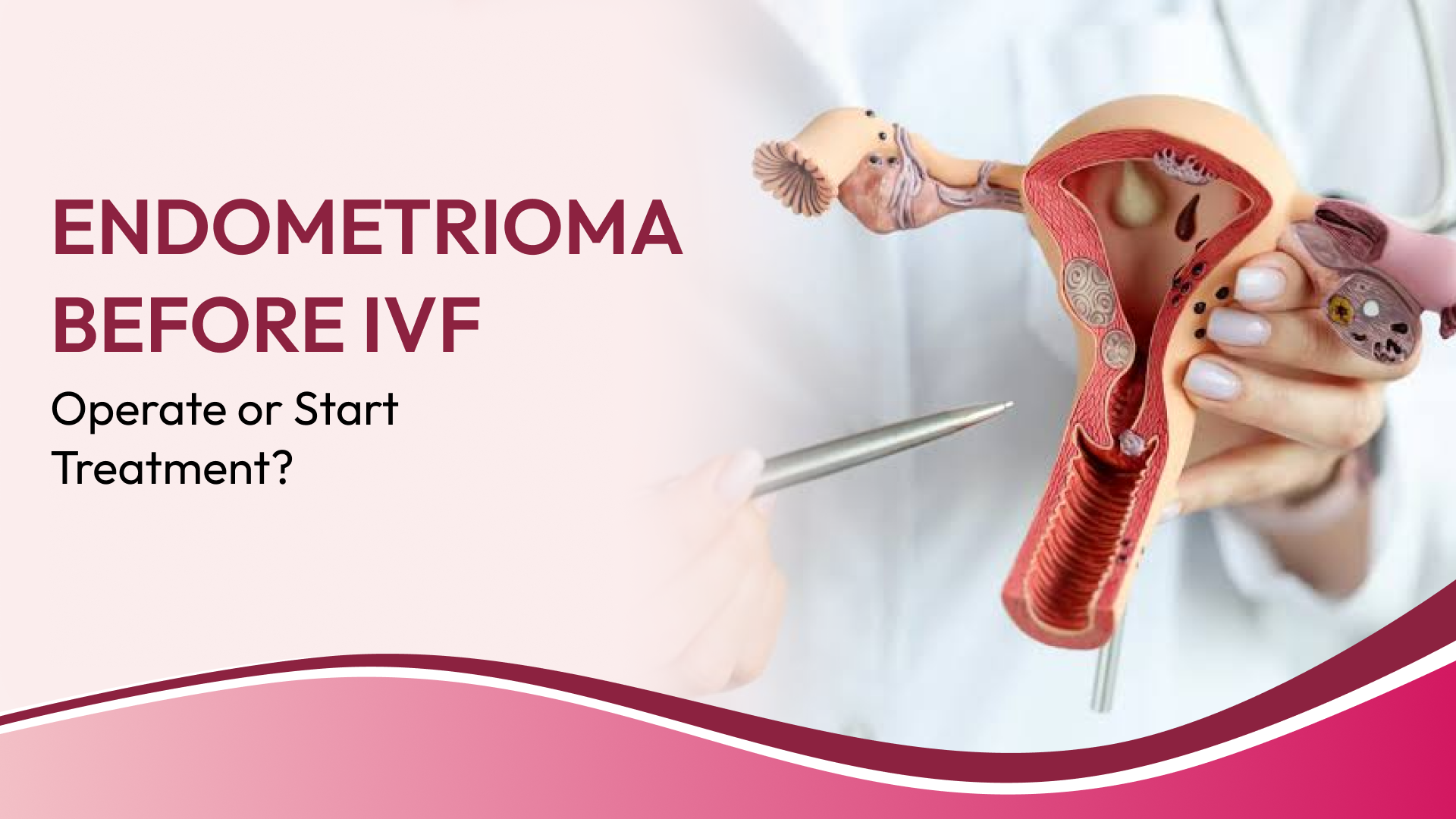
An ovarian endometrioma forms when endometriotic tissue grows on or within the ovary. The cyclical bleeding of this tissue, with nowhere to drain, forms a cyst that gradually enlarges. The old blood inside thickens to a characteristic dark brown colour — giving rise to the name ‘chocolate cyst.’
Endometriomas are not simple cysts. They are embedded within the ovarian cortex — the outer layer of the ovary where eggs (follicles) are stored and mature. The proximity of the cyst to the normal ovarian tissue means that both the cyst itself and any surgery to remove it can damage the pool of remaining eggs (ovarian reserve).
How Do Endometriomas Affect Fertility and IVF?
Impact on Ovarian Reserve
Multiple studies have shown that ovarian endometriomas are associated with reduced ovarian reserve, as measured by anti-Müllerian hormone (AMH) levels and antral follicle count (AFC). The cyst wall directly destroys surrounding follicles through mechanical pressure, oxidative stress from the cyst contents, and local inflammatory processes.
Impact on IVF Stimulation
- Women with endometriomas typically produce fewer eggs in response to ovarian stimulation
- Egg quality may be affected by the hostile follicular environment surrounding the cyst
- Access to follicles during egg retrieval may be technically more difficult
- Risk of cyst puncture during egg retrieval — potentially contaminating the follicular fluid and damaging eggs
Impact on Implantation
Even after successful egg retrieval and fertilisation, endometriosis-related inflammation may affect endometrial receptivity and implantation, contributing to lower success rates in some studies.
The Problem with Surgery: Endometrioma Removal Also Damages the Ovary
Here is the central dilemma: endometriomas damage the ovary, but surgery to remove them can also damage the ovary. Studies have consistently shown that ovarian cystectomy (removal of the endometrioma with its cyst wall) reduces ovarian reserve, as measured by AMH levels, in the operated ovary. The reduction in AMH after endometrioma surgery is particularly significant when:
- The endometrioma is large (over 4 cm)
- The woman has bilateral endometriomas (both ovaries affected)
- The woman has previously had ovarian surgery
- The surgeon inadvertently removes healthy ovarian tissue along with the cyst wall
This is why the decision is not straightforward. Operating removes the cyst but at a cost. Not operating leaves the cyst but avoids the iatrogenic (surgery-induced) damage.
Current Evidence and Guidelines: When to Operate
Operate First — When Surgery Is Recommended Before IVF
- Endometrioma larger than 3–4 cm that is interfering with access to follicles during planned egg retrieval
- Diagnostic uncertainty — the cyst has features that make it impossible to confidently distinguish from a malignant ovarian tumour (unusual appearance on ultrasound, elevated CA-125)
- Significant pain symptoms attributable to the endometrioma that are affecting quality of life
- Rapid growth of the cyst on serial ultrasound monitoring
- Women who have not previously had ovarian surgery on the affected side
- Bilateral endometriomas where access to eggs from either ovary is compromised
Proceed Directly to IVF — When Surgery May Be Best Avoided
- Endometrioma smaller than 3 cm — the risk-benefit balance generally favours proceeding to IVF without surgery
- Diminished ovarian reserve — if AMH is already low, the further reduction from surgery may be unacceptable
- Advanced maternal age (over 37) — time is a critical resource and surgery plus recovery adds months
- Previous ipsilateral ovarian surgery — operating on an already-operated ovary carries a high risk of further ovarian damage
- Bilateral endometriomas where both ovaries have already been operated on
- Asymptomatic small cysts with no diagnostic uncertainty
Aspiration of Endometriomas During Egg Retrieval — Is It an Option?
Some IVF centres offer ultrasound-guided aspiration of the endometrioma fluid at the time of egg retrieval. This is technically feasible and avoids a separate surgical procedure. However:
- Endometriomas almost universally recur after aspiration alone — the cyst wall is not removed
- There is a risk of introducing the endometrioma fluid (which is toxic to eggs) into the follicular environment
- Aspiration does not address the inflammatory environment or the structural damage
Aspiration is therefore not a substitute for surgical cystectomy and is offered selectively rather than routinely.
Surgical Technique Matters — Protecting Ovarian Reserve During Cystectomy
When surgery is indicated, the technique used by the surgeon is critically important in determining how much ovarian reserve is preserved. The key principles:
- Careful identification of the correct cleavage plane between the cyst wall and normal ovarian tissue
- Avoidance of excessive use of electrosurgical energy (diathermy) near the ovarian cortex — heat causes irreversible follicle damage
- Gentle, careful stripping of the cyst wall — the ‘stripping technique’ — rather than aggressive dissection
- Minimal removal of surrounding ovarian tissue
An experienced laparoscopic surgeon who regularly performs endometrioma cystectomy can achieve complete removal of the cyst while minimising damage to the surrounding ovarian tissue. This is one of the most technically demanding aspects of reproductive laparoscopic surgery.
Post-Surgical Fertility Planning
After laparoscopic endometrioma cystectomy, the typical recommendation is:
- Allow 2–3 months for ovarian recovery before starting IVF stimulation
- Reassess AMH and AFC at 3 months post-surgery to understand the new ovarian reserve status
- If the pre-operative AMH was already low, start IVF without delay once surgical recovery is complete
- Consider medical suppression (GnRH agonist or progesterone) in the post-operative period to prevent rapid recurrence
Recurrence of endometriomas is a reality — the 3-year recurrence rate is approximately 30–40%. This reinforces the importance of not delaying IVF after surgery. The post-surgical window represents the best opportunity for conception.
Dr. Sonil Srivastava — Endometrioma Surgery and IVF in Bhopal
Dr. Sonil Srivastava provides complete care for women with ovarian endometriomas at her fertility and laparoscopy centre in Arera Colony, Bhopal. She is recognised as one of the best IVF specialists and laparoscopic surgeons in Bhopal, with the expertise to:
- Accurately assess each patient’s individual situation using ultrasound, AMH, and AFC
- Make an evidence-based recommendation on whether surgery is needed before IVF or whether IVF should proceed directly
- Perform laparoscopic endometrioma cystectomy with meticulous technique to preserve ovarian reserve
- Coordinate surgery and IVF planning seamlessly, minimising the time between intervention and fertility treatment
If you have been diagnosed with an ovarian endometrioma and are planning IVF in Bhopal, a consultation with Dr. Sonil Srivastava will give you a clear, individualised plan.
Consult Dr. Sonil Srivastava — Best Gynaecologist in Bhopal
E-3/148, Arera Colony, Bhopal, MP 462016 | +91-9897576976 | drsonilsrivastava.in